Can I Get Workers’ Compensation As a Healthcare Worker?
Healthcare employers are responsible for maintaining safe work environments and for covering costs when employees get hurt on the job. Despite those obligations of occupational safety, work-related injuries happen every day in hospitals, clinics, nursing homes, and other healthcare facilities. When they do, navigating the workers’ compensation system can feel confusing and overwhelming, especially while you are also trying to recover. An experienced workers’ compensation attorney can cut through the complexity, protect your rights, and help you pursue the full compensation you deserve.
If you are a healthcare employee in North Carolina who has been injured at work, Collier Law Workers’ Compensation Attorney is ready to fight for you. Our team understands the unique challenges healthcare professionals face and is committed to securing a fair settlement on your behalf. Contact us today to schedule a free consultation.

What Is Workers’ Compensation?
Workers’ compensation is a state-regulated insurance program that provides benefits to employees who suffer work-related injuries or illnesses. In North Carolina, most employers with three or more employees are required by North Carolina law to carry workers’ compensation insurance. The North Carolina Workers’ Compensation Act governs how claims are filed, what benefits are available, and how disputes are resolved.
The workers’ compensation system is designed to be a no-fault system. That means an injured worker does not need to prove that their employer was negligent to receive benefits. As long as the injury occurred in the course of your job duties, you may be entitled to compensation for medical expenses, lost wages, and other losses.
Do Healthcare Employees Get Workers’ Comp Benefits?
Yes. Healthcare workers are covered under North Carolina workers’ compensation law just like employees in any other industry. If you were injured while performing your job duties, you have the right to file a workers’ compensation claim.
Workers’ compensation coverage typically extends to a wide range of healthcare professionals, including:
- Registered nurses (RNs) and licensed practical nurses (LPNs)
- Physicians, surgeons, and resident doctors
- Nursing assistants and patient care technicians
- Radiologists, lab technicians, and imaging staff
- Physical therapists, occupational therapists, and speech therapists
- Emergency medical technicians (EMTs) and paramedics
- Hospital orderlies and transport staff
- Administrative and health administration personnel
- Home health aides and hospice workers
- Janitorial and housekeeping staff at healthcare facilities
If you work in the healthcare industry and were hurt on the job, you likely qualify for workers’ comp benefits regardless of your specific role.
What Are Some Common Workplace Injuries In Healthcare?
Healthcare workers face a higher risk of on-the-job injury than workers in many other fields. The physical and environmental demands of patient care create unique hazards that can lead to serious harm.
Common workplace injuries in healthcare include:
- Musculoskeletal and Orthopedic injuries: Back, shoulder, and joint injuries are among the most frequent claims in the healthcare industry. Lifting patients, repositioning individuals in beds, and assisting with transfers put intense strain on the body.
- Slip and fall accidents: Wet floors, cluttered hallways, and fast-paced environments make slip and fall accidents a constant risk in hospitals and clinics.
- Workplace violence: Healthcare workers are disproportionately affected by violence from patients, visitors, and others. Assaults can result in serious physical and psychological injuries.
- Exposure to infectious diseases: Direct contact with patients and contaminated materials puts healthcare professionals at risk of contracting illnesses, including respiratory infections and other communicable diseases.
- Overexertion and repetitive stress injuries: Performing the same physical motions repeatedly during long shifts leads to chronic conditions that can become permanently disabling.
What Benefits Are Available Through Workers’ Compensation for Healthcare Workers?
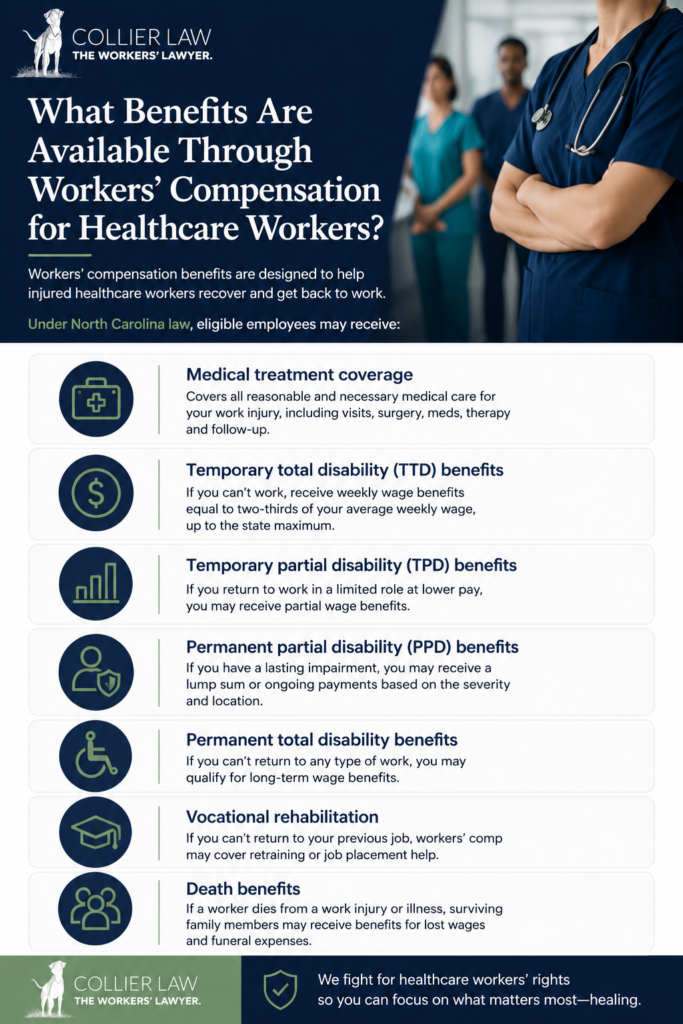
Workers’ compensation benefits are intended to help injured workers cover their losses and return to work when possible. Under North Carolina workers’ compensation law, eligible healthcare employees may receive:
- Medical treatment coverage: All reasonable and necessary medical expenses related to your work injury are covered, including doctor visits, surgeries, prescriptions, physical therapy, and follow-up care.
- Temporary total disability (TTD) benefits: If your injury prevents you from working, you may receive weekly wage replacement benefits equal to two-thirds of your average weekly wage, up to the state maximum.
- Temporary partial disability (TPD) benefits: If you can return to work in a limited capacity at reduced pay, you may be entitled to partial wage replacement.
- Permanent partial disability (PPD) benefits: If your injury results in a permanent impairment, you may receive a lump sum or ongoing payments based on the severity and location of the impairment.
- Permanent total disability benefits: Workers who are permanently and totally unable to return to any employment may qualify for long-term wage replacement.
- Vocational rehabilitation: If you cannot return to your previous position, workers’ comp may cover retraining or job placement assistance.
- Death benefits: Surviving family members may be entitled to compensation for lost wages and funeral expenses if a worker dies from a work-related injury or illness.
How Do I File a Workers’ Comp Claim?
Acting quickly after a workplace injury is critical. North Carolina law sets strict deadlines, and delays can jeopardize your claim.
Here are the basic steps for filing a workers’ compensation claim:
- Report your injury immediately. Notify your supervisor or employer as soon as possible after the incident. North Carolina law requires injured workers to report workplace injuries within 30 days. Failing to report on time can result in a denial of benefits.
- Seek medical treatment. Your employer or their workers’ compensation insurance carrier has the right to direct you to an authorized medical provider. Follow that process unless you need emergency care.
- Document everything. Keep records of how the injury occurred, the names of witnesses, any medical treatment you receive, and all communications with your employer and their insurer.
- File Form 18 with the NC Industrial Commission. To formally preserve your claim, you must file a written notice of injury (Form 18) with the North Carolina Industrial Commission within two years of the date of your injury.
- Cooperate with the claims process. Attend all medical appointments, respond to requests from the insurer, and follow treatment recommendations from authorized providers.
- Consult a workers’ compensation attorney. Before accepting any settlement or signing any documents, speak with an attorney who understands North Carolina workers’ compensation law.
Should I Hire a Workers’ Compensation Lawyer?
Many workers’ comp claims do not go smoothly. Insurers have a financial interest in minimizing payouts, and healthcare employers sometimes dispute whether an injury was truly work-related. An experienced workers’ compensation attorney levels the playing field, and it’s important to hire one to help you with your case.
Handling denied claims: If your claim has been denied, an attorney can investigate the reason for the denial, gather supporting evidence, and appeal the decision through the NC Industrial Commission.
Challenging inadequate benefit offers: Insurers sometimes offer settlement amounts that fall far short of what an injured worker actually needs. A lawyer can evaluate any offer against the full scope of your medical expenses, lost wages, and long-term needs before you agree to anything.
Navigating occupational disease claims: Conditions like musculoskeletal injuries from years of lifting patients, or illnesses resulting from needlestick injuries or infectious disease exposure, can be difficult to connect to a specific workplace incident. An attorney knows how to build and document these claims effectively.
Protecting your rights during treatment: Disputes over authorized medical treatment, the extent of a permanent impairment, or your ability to return to work are common. Legal representation ensures those disputes are resolved fairly.
Managing the paperwork and deadlines: Workers’ compensation claims involve strict deadlines, complex forms, and procedural requirements. Missing a deadline can eliminate your right to benefits entirely.
Why Should I Choose Collier Law Workers’ Compensation Attorney?
When a workplace injury turns your life upside down, you need an advocate who takes your case personally. At Collier Law Workers’ Compensation Attorney, we focus exclusively on workers’ compensation law in North Carolina. We understand the physical demands of working in healthcare and the serious consequences that a disabling injury can have on your career, your income, and your family.
We have guided healthcare workers through every type of workers’ comp claim, from straightforward injuries to complex disputes involving permanent disability, occupational disease, and insurer bad faith. Our approach is direct and transparent. We explain your rights clearly, keep you informed at every stage, and fight aggressively for every dollar of compensation you are owed.
You should not have to take on an insurance company alone after suffering a work-related injury. Let Collier Law handle the legal battle while you focus on recovering. Contact Collier Law Workers’ Compensation Attorney today to schedule your free consultation.